
BIM in Construction: A Complete Guide to BIM for Modern Projects
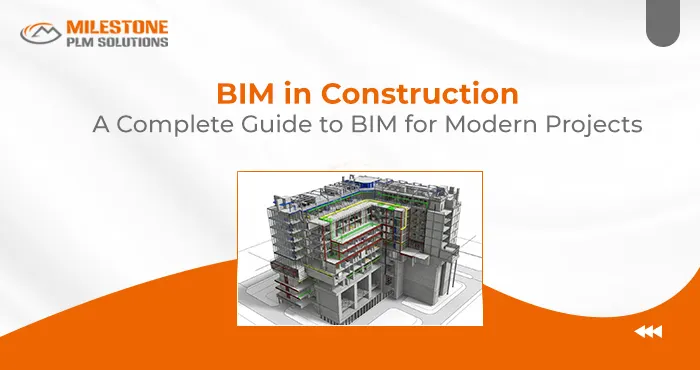
Building Information Modeling (BIM) in construction has transformed how contractors can deliver their projects while providing improved efficiency and coordination. As construction has developed steadily over time with increasing levels of complexity, traditional construction processes can no longer support the development of these types of projects using construction methods developed many years ago.
In the guide, we will cover the basics of Building Information Modeling (BIM), including answers to frequently asked questions, its real-world applications, and how our team of professionals at Milestone PLM Solutions provides support for contractors, developers and project stakeholders who use BIM.
What Is Building Information Modeling (BIM)?
Building Information Modeling (BIM) is an integrated digital methodology that enables the development of parametric models, composed of 3D geometry, metadata, and documentation that defines and monitors all aspects of a building throughout its long-term lifecycle.
Unlike traditional drafting, which only provides drawings, BIM integrates all aspects of design, coordination, and construction into one single, reliable digital environment. As a result, BIM has become the foundation for the way we now deliver our buildings.
Why BIM in Construction Is No Longer Optional
The construction industry faces many challenges including project overruns, design inconsistencies, and delays in scheduling. BIM addresses all of these challenges through better coordination, visibility, and improved decision-making prior to construction taking place.
For both professionals and owners, BIM reduces uncertainty and increases project confidence.
BIM vs CAD: Understanding the Difference
One of the most common questions is BIM vs CAD.
- CAD focuses on creating drawings.
- BIM focuses on managing information.
With BIM:
- Models are data-driven, not just visual.
- Changes update automatically across all views.
- Coordination happens before construction, not during it.
This shift explains why BIM has replaced CAD-centric workflows on complex projects.
BIM Coordination and Clash Detection Explained
BIM coordination is the process of integrating architectural, structural, and MEP models into a single federated model.
Through BIM clash detection, conflicts such as:
- Ducts intersecting beams
- Pipes clashing with cable trays
- Structural elements conflicting with services are identified and resolved digitally saving significant time and rework during construction.
Understanding BIM Dimensions: From 1D to 11D
BIM in construction extends far beyond modeling. Each BIM “dimension” represents an additional layer of intelligence that supports better decision-making across the entire project lifecycle.
| Dimension | Focus Area | Key Benefits |
|---|---|---|
| 1D BIM | Concept & Information Planning | Early-stage feasibility and information requirements |
| 2D BIM | Drafting & Documentation | 2D drawings for approvals and documentation |
| 3D BIM | Visual Modeling & Design | Intelligent 3D models with embedded data |
| 4D BIM | Time & Construction Scheduling | Links models to schedules for sequencing & logistics |
| 5D BIM | Cost Estimation & Budget Control | Integrates quantities & cost data for budgeting |
| 6D BIM | Facility Management & Asset Data | Supports post-construction operations |
| 7D BIM | Sustainability & Energy Performance | Energy analysis, carbon footprint, green building compliance |
| 8D BIM | Health & Safety Management | Visualize & plan for safety hazards |
| 9D BIM | Lean Construction & Quality Control | Supports lean principles & quality assurance |
| 10D BIM | Construction Industrialization & Automation | Modular construction & prefabrication efficiency |
| 11D BIM | Digital Twin & Smart Asset Integration | Connects models with real-time data for smart management |
BIM for Contractors: Practical On-Site Value
BIM for contractors improves construction execution by:
- Enhancing buildability reviews
- Reducing RFIs and change orders
- Supporting construction sequencing
- Improving trade coordination
For contractors, BIM is a tool for risk reduction and productivity—not just design support.
BIM for Developers and Project Owners
BIM for developers delivers visibility and control at every stage of the project.
Benefits include:
- Better design clarity
- Accurate cost and schedule forecasting
- Reduced construction risk
- Reliable as-built data for future use
BIM helps developers make informed decisions long before construction begins.
Digital Twin Construction and the Evolution of BIM
Digital twin construction extends BIM beyond design and construction by connecting models with real-time operational data.
While BIM focuses on planning and delivery, digital twins support:
- Asset monitoring
- Performance optimization
- Predictive maintenance
This evolution allows BIM data to remain valuable long after project handover.
AI in BIM: The Next Stage of Innovation
AI in BIM is transforming how models are created, analyzed, and optimized.
AI supports:
- Automated clash detection
- Faster quantity take-offs
- Design optimization
- Predictive construction insights
AI-driven BIM enhances efficiency while reducing manual effort and human error.
BIM Services by Milestone PLM Solutions
It is one thing to have a general concept of BIM and its dimensions, it is quite another to successfully put BIM into practice. At Milestone PLM Solutions, we provide full-service BIM services to Contractors, Developers, and Project Owners across the globe.
Our Services Include:
- Architectural, Structural, and MEP BIM modeling services
- BIM coordination and BIM clash detection
- 4D BIM construction scheduling
- 5D BIM cost estimation and quantity take-offs
- As-built and record BIM models
- Scan to BIM services
Our highly experienced BIM team works with each customer to create strategies that leverage BIM to minimize risk, manage expenses, and maximize project productivity. Please reach out to us today if you would like to implement BIM on your project.
Final Thoughts: BIM in Construction as a Strategic Advantage
BIM is no longer just a way for architects to visualize their designs but also as a way for architects and contractors to effectively manage and track their projects throughout the project’s entire life cycle. With the right strategy for implementing your BIM solution and the right team of professionals to help train your staff on how to use it, BIM becomes a long-term asset for your firm rather than simply a tool for individual projects.
Frequently Asked Questions
1. What does BIM mean in construction?
Building Information Modeling (BIM) is a digital methodology that integrates 3D models, data, and documentation to plan, design, and manage construction projects efficiently throughout their lifecycle.
2. What are the applications of BIM in construction?
BIM is used for design visualization, clash detection, construction scheduling, cost estimation, facility management, sustainability analysis, and risk reduction in modern construction projects.
3. How does BIM improve coordination and collaboration on construction projects?
BIM provides a centralized model where architects, engineers, and contractors can work together, share accurate information, detect clashes early, and make informed decisions.
4. What is the difference between BIM and traditional CAD?
Unlike CAD, which focuses only on drawings, BIM is data-driven, updates changes automatically across all views, and allows construction planning, scheduling, and cost management before building begins.
5. Can BIM help reduce construction costs and project delays?
Yes, BIM helps minimize errors, optimize scheduling, detect clashes early, and provide accurate quantity take-offs and budgeting, reducing both costs and delays significantly.