
Why 3D LiDAR Scanning is the Backbone of the Scan to BIM Process?
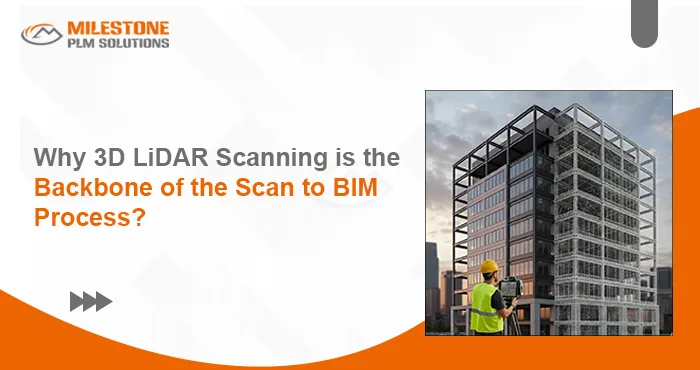
In these fast-paced times of AEC (architecture, engineering and construction), the three cornerstones for all successful delivery are: precision, speed, and data integrity. As the digital revolution redefines industry, there’s one technology that is fast becoming a game-changer – 3D LiDAR Scanning. Whether they’re scanning complex architectural details, simplifying renovation workflows, or reducing human error, LiDAR has transformed how Scan to BIM (Building Information Modeling) professionals move from the real world into digital models. For further insight into why 3D LiDAR Scanning is the backbone of the Scan to BIM process and plays into precision, productivity, and success on every project.
Understanding the Scan to BIM Process
Now, before we jump to the importance of LiDAR technology, let’s address what is Scan to BIM. Scan to BIM involves the capturing of existing buildings through 3D scanning (such as LiDAR), and turning that data into a precise BIM model. This model is a digital twin of the actual building or infrastructure in the physical world, providing architects, engineers and facility managers with access to data for making informed decisions from the initial design phase through occupancy, maintenance and future growth.
In simple terms:
- Scan = capturing real-world conditions through laser scanning.
- BIM = converting those scans into an intelligent 3D model with detailed information.
There is no way to create an accurate or complete BIM without high-precision scanning, and that’s why LiDAR scanning is always essential.
What is 3D LiDAR Scanning?
LiDAR stands for Light Detection and Ranging, a remote sensing method that uses laser pulses to measure the distance between the scanner and objects around it. These measurements produce millions of data points — collectively referred to as a point cloud — that capture the shape and surface texture of the environment in three dimensions.
LiDAR scanners can be:
- Terrestrial (static): Mounted on tripods for scanning buildings or interiors.
- Mobile: Attached to vehicles for large infrastructure or roadway mapping.
- Aerial (drone-based): Ideal for scanning landscapes, bridges, and tall structures.
Its capability to gather data with millimetric accuracy and represent complex geometries renders this technology the most accurate basis for BIM modeling.
Why 3D LiDAR Scanning is Backbone of Scan to BIM ?
Let’s take a deeper look at why LiDAR technology is so important to the Scan to BIM process.
1. Unmatched Accuracy and Detail
At the core of any BIM model is the accuracy and LiDAR captures it perfectly. Instead of traditional manual measurement methods or photogrammetry, LiDAR scanners collect millions of accurate data points a second. This ensures:
- Accurate dimensions of complex geometries.
- Elimination of human measurement errors.
- Perfect alignment with real-world conditions.
When you bring this point cloud data into a BIM program like Revit, ArchiCAD or Navisworks it becomes an accurate representation of reality that designers can trust to be competent with.
2. Faster Data Collection and Project Turnaround
Time means money in construction — and LiDAR scanning saves a lot of both. It used to take weeks of manual site surveying — now it’s done in hours with 3D LiDAR. The scanner paints entire areas in one pass, ensuring complex rooms and subtle features are not overlooked.
This rapid data acquisition accelerates:
- Site analysis and design validation.
- BIM model creation and documentation.
- Project decision-making and coordination.
The result? Projects move faster without compromising quality.
3. Minimizing Human Error
When it comes to traditional surveying, manual tools, such as tape measures or total stations, can introduce errors. Even a slight discrepancy can result in major design rework or conflicts in the field. The data are objective and consistent with digital LiDAR scanning. Each scan is a “snap shot” in time, capturing as-built conditions as they exist and serving as the One Source of Truth for architects, engineers and contractors. This drastically reduces rework, clashes, and costly revisions during the design or construction stages.
4. Comprehensive Data for Complex Structures
When it comes to heritage buildings, industrial plants, or MEP-heavy environments, collecting the utmost detail of every nook and cranny can be difficult. This is where LiDAR comes in handy. It generates a high-density point cloud that includes some of the most minor details that could be missed by the human eye, such as curves, irregular structures, and tight places. In essence, this holistic dataset allows BIM modelers to recreate current structures with surprising accuracy, ignoring complexity.
5. Seamless Integration with BIM Software
Point cloud data obtained from LiDAR is readily consumed by widely used BIM software. LiDAR data can be imported directly into software such as Autodesk ReCap, Revit, Bentley Pointools or Navisworks- from this point professionals can:
- Create accurate as-built BIM models.
- Perform clash detection and space planning.
- Analyze construction deviations in real time.
This data integration ensures that everyone, from architects to building systems operators, collaborates on a single knowledge-rich model based on actual conditions in the field.
6. Enhancing Renovation, Restoration, and Facility Management
When working on existing structures, as-built documentation is crucial—but often outdated or incomplete. LiDAR scanning bridges this gap perfectly.
By generating precise as-built models, teams can:
- Plan renovations without damaging existing structures.
- Restore heritage buildings while maintaining their original integrity.
- Manage facilities efficiently using digital twins for maintenance and operation.
This ensures that every decision-from renovation planning to lifecycle management-is informed by accurate digital data.
7. Cost-Efficiency and Long-Term ROI
While LiDAR equipment may seem expensive initially, the return on investment is undeniable. The technology helps:
- Avoid costly site revisits.
- Reduce material wastage due to design errors.
- Minimize rework and schedule delays.
Over time, the efficiency and precision LiDAR brings to the Scan to BIM process far outweighs its upfront cost.
8. Supporting Digital Twins and Smart Infrastructure
LiDAR data doesn’t just stop at BIM—it paves the way for Digital Twin creation.
Digital twins are dynamic, real-time digital representations of physical assets that support smart facility management and predictive maintenance. LiDAR’s ability to update BIM models with precise scans ensures that the digital twin always reflects current, real-world conditions, enabling smarter, data-driven infrastructure management.
The Future of Scan to BIM with LiDAR Technology
As the AEC industry continues to embrace digital transformation, the integration of advanced scanning technologies—like LiDAR—is redefining how projects are documented and modeled. Emerging innovations such as AI-driven point cloud processing, automated BIM modeling, and cloud-based collaboration are making Scan to BIM workflows more efficient, intelligent, and scalable.
With the increasing accessibility of drones, handheld scanners, and mobile scanning devices, Scan to BIM is rapidly becoming a standard practice across renovation, construction, and facility management projects. These advancements are paving the way for more accurate, data-rich digital environments that enhance decision-making and project outcomes.
Which is the Best Scan to BIM Service Provider?
Choosing the right Scan to BIM partner can make all the difference in achieving accuracy, efficiency, and project success. Among the few companies that truly stand out in this domain, Milestone PLM Solutions has earned a strong reputation for delivering precise and reliable BIM models created from LiDAR and point cloud data captured by clients or survey partners.
With a team of skilled BIM professionals, Milestone specializes in transforming complex scan data into detailed, information-rich 3D models that align perfectly with real-world conditions. Every project—whether it’s a renovation, retrofit, or large-scale construction—is executed with exceptional attention to detail and coordination.
Through its comprehensive Scan to BIM modeling solutions, Milestone PLM Solutions helps architects, engineers, and contractors achieve seamless digital transformation, improved collaboration, and smarter project outcomes that reduce cost and rework.
Conclusion
3D LiDAR scanning has transformed how we capture, design, and manage built environments, serving as the true backbone of the Scan to BIM process by providing highly accurate, reliable, and comprehensive data that bridges the physical and digital worlds. From speeding up surveys and eliminating errors to enabling intelligent, data-driven BIM workflows, LiDAR ensures every digital model is precise and actionable. By harnessing this technology, Milestone PLM Solutions delivers expert Scan to BIM services that help organizations achieve smarter, more efficient, and future-ready infrastructure projects.
Follow Milestone PLM Solutions for Architecture Industry Updates, CAD Tips and Global Architecture News.
Milestone PLM Solutions, with its exclusive delivery center in India, is a global CAD, BIM & Architectural Design services outsourcing partner, serving the needs of the Architecture, Interior, and Construction industry since 2004. MILESTONE focuses on the unique needs of clients and believes in tackling real-life design challenges with efficiency, smoothness, and ease.
The MILESTONE team can assist you with Architectural Design, 3D Modeling, Drafting & Detailing, BIM Modeling, Rendering, and more. We support multiple software including AutoCAD, Revit, ArchiCAD, SketchUp, 3ds Max, and Navisworks. Our approach is to provide a dedicated team for each customer over ongoing projects and consistently deliver high-quality output.
With our state-of-the-art technology and a large talent pool of engineers, we develop best-in-class solutions for clients across the globe. We align with your culture and values to form unbreakable partnerships and are primed for success with over 100 employees and 150 customers in the US, Europe, India, and Asia.
You can email us at info@milestonetech.net and can log in to our website www. milestonetech.net to know more about our services and our work portfolio or contact us on +1-302-305-6018