
Shop Drawings vs As-Built Drawings: Differences, Importance, and Best Practices
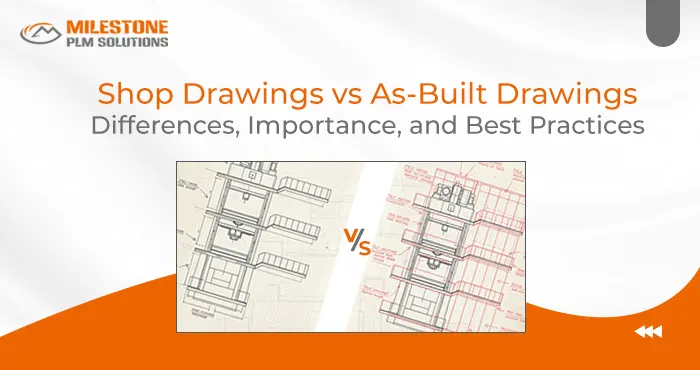
In current-day construction, inaccurate documentation can affect the cost, quality, and duration of the project. One of the biggest confusions in project documentation has to do with shop drawings vs as built drawings, which many assume are the same, though they are used for distinctly different purposes in different stages of the project. This blog post explains the complete difference between shop drawings and as-built drawings.
What Are Shop Drawings?
Shop drawings are the detailed technical drawings that the contractor, fabricator, supplier, or BIM engineer prepares before construction. These drawings transform intent into fabrication and installation-ready details.
Unlike architectural or consultant drawings, the shop drawing will deliver the exact dimension, materials, tolerances, and connection details that are needed to execute on-site.
Key Components of Shop Drawings
- Identifying components by tags and references
- Exact dimensions & coordinates
- Specifications of materials and finish
- Clearance and interference specifications
- Sectional views & Installation steps
The shop drawings also go through a review and approval procedure before the actual fabrication is carried out.
Importance of Shop Drawings
The importance of the shop drawings mainly lies in their role in preventing any errors in the construction process by addressing any technical difficulties that may –
- Reduce conflicts & rework
- Enhance coordination of trade activities
- Enable the optimization of fabrication accuracy
- Minimize project delays and cost overruns
- Facilitate and ensure smooth on-site
They are the linkage point or bridge that connects design and construction.
What Are As-Built Drawings?
As-built drawings are the final record drawings produced after the completion of any construction. These drawings include what actually exists at the end of the project, including all changes made during construction and which reflect changes from the approved drawings.
Also called record or redline drawings, as-builts reflect the actual construction of the building.
Key Components of As-Built Drawings
- Actual locations of walls, equipment, and systems
- Field modifications and rerouted services
- Material substitutions
- Dimensional and elevation changes
- Final installation details
Teams typically prepare as-built drawings using site markings and updated BIM models.
Importance of As-Built Drawings
As-built drawings play an important role in building ownership and facility management.
- Support maintenance and repairs
- Assist in the detection of hidden systems
- Facilitate Safe Renovation & Expansion
- Help in emergency planning
- Used as permanent records of construction
They provide long-term clarity even after the projects are completed (handover).
Shop Drawings vs As-Built Drawings: Key Differences Explained
| Aspect | Shop Drawings | As-Built Drawings |
|---|---|---|
| Project Stage | Created before construction begins | Created after construction is completed |
| Primary Purpose | Guide fabrication and installation | Document the final constructed condition |
| Content Focus | Planned dimensions, materials, sections, and assembly details | Actual dimensions, locations, and site modifications |
| Nature of Information | Predictive and instructional | Historical and record-based |
| Revisions | Revised during coordination and approvals | Finalized after construction |
| Prepared By | Contractors, subcontractors, fabricators, BIM teams | Contractors or BIM engineers |
| Usage | On-site execution and fabrication | Maintenance, renovation, and facility management |
| Clash Detection | Used to identify and resolve clashes before construction | Reflects resolved and executed systems |
| Legal/Record Value | Supporting document for construction | Official project record after handover |
Best Practices for Shop Drawings and As-Built Drawings
- BIM based coordination to identify clashes early
- Use standard drawing practices and naming conventions
- Update redlines periodically.
- Verify site conditions before finalizing as-built drawings
- Project teams must approve all shop drawings before fabrication
Following best practices helps to ensure accuracy during the entire project life cycle.
Which company provides best shop drawing and as-built drawing services?
Milestone PLM Solutions provides end-to-end shop drawing services and as-built drawing services for architectural, structural, and MEP projects.
Our Service Capabilities
- Fabrication-Ready 2D & 3D Shop Drawings – AutoCAD and Revit-based drawings with high dimensional accuracy.
- Accurate As-Built Documentation – Updated drawings reflecting real on-site conditions.
- BIM Coordination & Clash Detection – Coordinating multi-disciplinary models to eliminate errors before execution.
- Fast Turnaround & Scalable Support – Reliable delivery aligned with project schedules.
We help bridge the gap between design intent and construction reality.
Conclusion
Understanding shop drawings vs as-built drawings, and vice versa, is critical to the success of the construction process. Shop drawings ensure proper execution, whereas as-built drawings are a record of the actual scenario of what has been built.
Together they reduce risk, enhance coordination, and support the long-term building performance. Milestone PLM Solutions ensures correct BIM-driven documentation at every project stage.
Frequently Asked Questions
1. What is the main difference between shop drawings and as-built drawings?
Shop drawings are created before construction to guide fabrication and installation, while as-built drawings are prepared after construction to document the actual on-site conditions and changes.
2. Are shop drawings required for MEP projects?
BIM is used for design visualization, clash detection, construction scheduling, cost estimation, facility management, sustainability analysis, and risk reduction in modern construction projects.
3. Are as-built drawings mandatory after project completion?
In most commercial and infrastructure projects, as-built drawings are required for handover, facility management, future renovations, and compliance documentation.
4. Can shop drawings be converted into as-built drawings?
Yes. Approved shop drawings can be updated with site redlines, field modifications, and final installations to create accurate as-built drawings at project completion.
5. How do BIM models improve shop drawings and as-built drawings?
Yes, BIM helps minimize errors, optimize scheduling, detect clashes early, and provide accurate quantity take-offs and budgeting, reducing both costs and delays significantly.