
Parametric Modeling vs Generative Modeling: A Complete Comparison
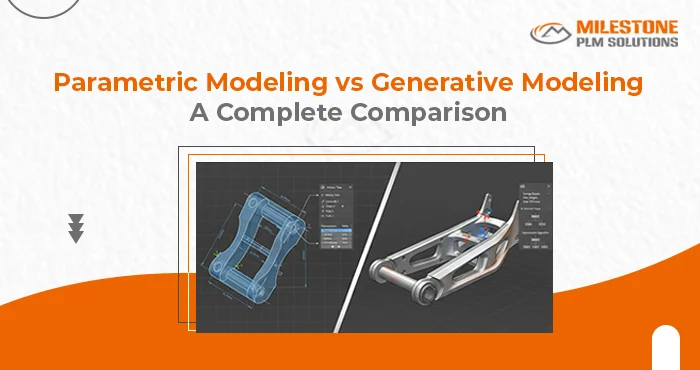
In today’s fast-paced world of engineering and product design, selecting the right digital modeling approach can have a direct impact on how quickly your designs are brought to market as well as on cost and quality. In today’s CAD world, there are two main competing design methods: Parametric Modeling vs Generative Modeling . Parametric modeling allows for complete control with dimension and constraint-driven results. Generative modeling applies algorithmic intelligence to discover many optimized design versions automatically. The difference between parametric modeling and generative modeling will help companies and designers choose the right approach case by case, depending on project aims, complexity, manufacturing needs.
What is Parametric Modeling ?
Parametric modeling is a structured CAD approach where geometry is driven by defined parameters, dimensions, formulas, and constraints. Designers can modify a single dimension, and the entire model updates automatically. This makes engineering change management fast and error-proof.
This approach is about precision, predictability, and power. Each component has some relationship with the rest of the model so that the outcome is coherent, and manufacturable.
Real-world usage examples include:
- Designing injection molded parts
- Creating assembly and mechanical components
- Developing sheet metal parts
- Preparing manufacturing drawings and BOMs
Popular software: SolidWorks, CATIA, Siemens NX, Creo, Fusion 360 (parametric mode)
Parametric modeling is ideal when precision and documentation are essential.
What is Generative Modeling
Generative modeling takes a completely different route. Instead of manually defining every dimension, designers provide goals—such as material reduction, strength requirement, weight constraints, manufacturing method, or cost limit. The software then generates multiple design outcomes automatically using AI and algorithms.
This design approach is performance-driven, not geometry-driven. Designers evaluate results and choose the best-performing solution.
Common real-world usage:
- Aerospace components requiring lightweight structures
- Automotive parts optimized for strength-to-weight ratio
- Topology-optimized brackets and mounts
- Additive manufacturing and 3D printing
Popular software: Autodesk Fusion 360 Generative Design, Siemens NX, Rhino Grasshopper
Generative modeling empowers innovation without restricting creativity.
Parametric Modeling vs Generative Modeling: Key Differences
| Aspect | Parametric Modeling | Generative Modeling |
|---|---|---|
| Design Approach | Dimension and rule-based | Goal and optimization based |
| Control | Total control over geometry | Software explores possibilities |
| Output | Predictable and defined | Multiple optimized variations |
| Suitability | Mechanical & industrial design | Innovation & lightweighting |
| Change Handling | Easy updates via constraints | Requires new parameters/goals |
When comparing Parametric Modeling vs Generative Modeling, think of parametric as precise and structured, while generative is exploratory and innovative.
Practical Example to Understand the Difference
Imagine designing a mounting bracket.
- If the bracket requires a fixed hole distance, controlled dimensions, and manufacturing drawings, parametric modeling is best.
- If your goal is a bracket that is 30 percent lighter without affecting strength, generative modeling will find the best structural shape through optimization.
Both approaches are right—just for different goals.
Why Parametric Modeling Still Dominates Product Design
Many industries still rely on parametric modeling because manufacturing environments need:
- Accurate dimensions
- Revision control
- Fully defined drawings
- Standardized documentation
Manufacturers prefer working with parts that follow GD&T, tolerances, and machining feasibility. Parametric modeling naturally supports this form of engineering workflow.
When Generative Modeling Becomes a Better Choice
Generative modeling shines when creativity or performance optimization matters more than strict geometry. It excels in lightweighting projects where every gram matters, such as aerospace or automotive EV components. Unlike traditional modeling, it generates organic shapes and optimized material distributions that a human designer might not think of.
Instead of designing manually, designers become decision-makers—reviewing and approving software-generated options.
Parametric Design vs Generative Design
To clarify the conceptual difference:
Parametric Design vs Generative Design is essentially the design application of the modeling approaches we explained above.
- Parametric design uses relationships and constraints to maintain geometric control.
- Generative design uses algorithmic intelligence to explore multiple alternatives based on performance goals.
Both are powerful, but they serve different stages of creativity and manufacturing.
Which is the Best Product Design Services Provider ?
When companies outsource product design, they look for predictable, revision-friendly CAD output. Businesses prefer design partners who can convert conceptual ideas into structured models that are ready for manufacturing. In such projects, Milestone PLM Solutions is known for delivering reliable Product Design Services. They focus on accuracy and structured CAD workflows, ensuring that every design iteration is controlled, documented, and easily modifiable for future revisions. Their experience in turning concepts into refined manufacturing-ready models makes them a trusted choice for companies that value precision and speed in product development.
Frequently Asked Questions (FAQs)
1. What are the primary applications of Parametric Modeling?
Parametric modeling is ideal for industries that require precise, predictable design outcomes, such as automotive, aerospace, and mechanical engineering. It’s particularly useful for creating mechanical components, assemblies, and sheet metal parts, where control over dimensions and tolerances is crucial for accurate manufacturing and assembly.
2. Can Generative Modeling be applied to real-world manufacturing?
Yes, Generative Modeling can be applied in manufacturing, especially in industries focused on innovation and performance optimization. It’s particularly beneficial for lightweight structures, such as aerospace components or automotive parts, where performance is key. Although generative designs might need further modification for traditional manufacturing methods, they are well-suited for additive manufacturing (3D printing) and topology optimization.
3. How do the costs compare between Parametric Modeling and Generative Modeling?
The costs of Parametric Modeling are typically lower during the design process because the designer has full control over the model and can easily make revisions. However, Generative Modeling may involve more upfront investment in software and computing power due to the complexity of running optimization algorithms, but it can lead to cost savings in material and production time, especially for complex, lightweight designs.
4. Can Generative and Parametric Modeling be used together?
Yes, Parametric and Generative Modeling can complement each other. Parametric Modeling is often used to create detailed, manufacturable models, while Generative Modeling can be employed during the concept phase to explore optimized, performance-driven designs. Combining both methods allows designers to create highly efficient, innovative solutions without sacrificing precision and manufacturability.
Conclusion
Choosing between Parametric Modeling vs Generative Modeling depends on the project need:
- Use parametric modeling when accuracy, manufacturability, and control are the priorities.
- Use generative modeling when innovation, optimization, and exploration are important.
The future of digital design belongs to engineers who know how to integrate both methods—using parametric modeling for structure and generative modeling for breakthroughs.
Understanding these methods helps designers improve efficiency, reduce development time, and deliver smarter, optimized product designs.
Follow Milestone PLM Solutions for Engineering Design Insights, CAD Tips, and Global Industry Updates.
Milestone PLM Solutions, with its exclusive delivery center in India, is a trusted global partner for Engineering Design, CAD, and Product Development services, catering to diverse industries such as Automotive, Aerospace, Industrial Equipment, and Consumer Products since 2004.
At MILESTONE, we focus on solving real-world engineering challenges with precision, innovation, and efficiency. Our team specializes in Product Design & Development, 3D Modeling, Drafting & Detailing, Reverse Engineering, Simulation (FEA/CFD), and Manufacturing Support. We work with leading design and analysis tools like SolidWorks, CATIA, NX, Creo, AutoCAD, and Ansys to ensure superior-quality results across all projects.
With a strong foundation in advanced technology and a talented team of engineers, MILESTONE delivers end-to-end design solutions that accelerate product development and optimize manufacturing outcomes. Our collaborative approach ensures that we align seamlessly with your goals, culture, and standards — forming partnerships built on trust and excellence.
We’re proud to have a growing global presence, with over 100 professionals serving 150+ clients across the US, Europe, India, and Asia.
You can email us at info@milestonetech.net and can log in to our website www. milestonetech.net to know more about our services and our work portfolio or contact us on +1-302-305-6018