
OEM vs ODM: What’s the Difference in Engineering Design?
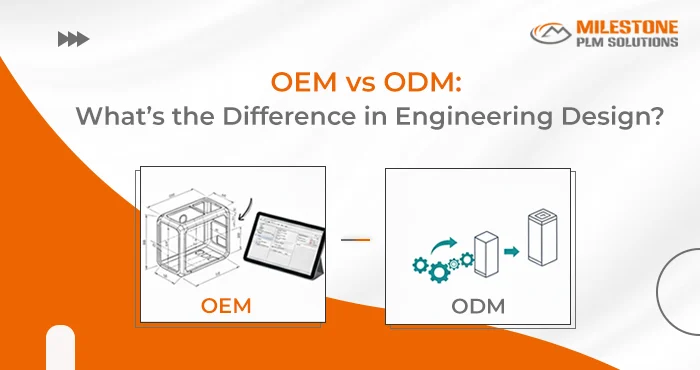
In engineering and product design, the difference between OEM and ODM is essential; it’s what determines how an idea becomes a real product. Both are key to the design and manufacturing ecosystem, but they serve two completely different purposes. OEMs (Original Equipment Manufacturers) concentrate on making components or products for a company and performing the design based on their specifications under a strict quality hardware design, that allows scalability and precision. Contrastly, ODMs (Original Design Manufacturers) take care of the entire product life cycle and provide a concept to market service. Understanding the OEM Vs ODM makes it easy for companies to select an approach that suits their engineering objectives and market requirements.
What is OEM (Original Equipment Manufacturer)?
An Original Equipment Manufacturer (OEM) focuses on manufacturing products designed by other companies. OEMS usually join together with companies that possess an advanced R&D division yet do not maintain high volume production facilities. These manufacturers ensure that each part meets exact specifications, tolerances and performance requirements specified by the client.
Key Characteristics of OEMs:
- Follow client-provided designs and engineering drawings.
- Ensure high precision, quality assurance, and scalability.
- Focus primarily on manufacturing rather than product design.
- Ideal for companies seeking mass production of custom-engineered parts
For example, a car engine part may be designed in CATIA or NX by a design group, however the CNC and QC machines making it on the assembly line are owned and maintained by an OEM.
What is ODM (Original Design Manufacturer)?
An ODM, or Original Design Manufacturer provides product development from the initial concept and CAD design to the mass production of the complete solution. For companies that do not have internal design capabilities, ODMs are useful for saving on R&D and for accelerating time-to-market.
Key Characteristics of ODMs:
- Create both the product design and prototype.
- Handle testing, manufacturing, and product branding.
- Offer customization options based on pre-developed templates.
- Help companies quickly introduce new products without heavy R&D investments.
For example, a fair number of consumer electronics brands take advantage of ODMs who already have engineered product designs that can be customized and branded.
Engineering Design Process in OEM and ODM
Typically, the engineering design process varies depending on if the project is OEM or ODM.
OEM Design Process:
- Client provides finalized CAD designs and specifications.
- The OEM develops prototypes for functional validation.
- Once approved, mass production begins under strict quality standards.
ODM Design Process:
- The ODM collaborates with the client to conceptualize the product.
- Engineers create detailed CAD models and simulations.
- Prototypes are tested using FEA or CFD tools for structural and performance accuracy.
- The ODM manufactures and delivers the finished, branded product.
In other words, OEMs manufacture the client’s designs with precision whereas ODMs take care of it from design to production.
Software Used in OEM vs ODM Design
Both OEMs and ODMs rely on advanced software to keep their products innovative, high quality, and accurate in terms of engineering.
- CAD Software: SolidWorks, CATIA, Siemens NX – for 3D modeling and detailed mechanical design.
- CAE Software: ANSYS, HyperWorks – for simulations, stress testing, and optimization.
- CAM Software: Mastercam, Fusion 360 – for production planning and CNC programming.
- PLM Systems: Teamcenter, Windchill – for collaborative data management.
Whereas OEMs use CAD & CAM to ensure manufacturing precision, ODMs leverage further simulation & analysis tools to fine-tune product design and performance even prior to production.
OEM vs ODM: Which One Should You Choose?
The right decision of OEM vs ODM would base on the strengths, resources and long-term goals of your company. If your business already employs a strong team of design, but you would like to work with someone who can be trusted for manufacturing quality products completed on time and within budget, then OEM is the right option. If you want an end to end solution from design to production with minimal R&D cost, ODM offers flexibility and quicker turnaround.
| Criteria | OEM | ODM |
|---|---|---|
| Design Ownership | Client | Manufacturer |
| Customization | Fully customizable | Limited options |
| Development Time | Longer | Shorter |
| Best For | Companies with design teams | Businesses seeking turnkey solutions |
Which is the Top Engineering Design Service Provider?
When selecting a reliable engineering design partner, it’s essential to find one that understands both OEM precision and ODM innovation. A trusted provider with years of experience in product design, CAD & Detailing, and manufacturing support—like a leading team at the forefront of engineering solutions—can help companies turn ideas into practical outcomes. By combining advanced software tools, simulation expertise, and deep industry knowledge, firms such as Milestone PLM Solutions enable businesses to design efficiently, manufacture effectively, and innovate confidently — ensuring seamless execution from concept to completion.
Frequently Asked Questions (FAQs)
1. What is the main difference between OEM and ODM in engineering design?
The key difference lies in ownership of the design. In an OEM (Original Equipment Manufacturer) model, the client provides the design and specifications, and the manufacturer produces it. In ODM (Original Design Manufacturer), the manufacturer creates both the design and the product, which the client can brand and sell.
2. Which is more cost-effective, OEM or ODM?
ODM is often more cost-effective for businesses that don’t want to invest heavily in R&D or product development. OEM, however, is ideal for companies that need custom designs or want to maintain complete control over product innovation.
3. What software tools are commonly used in OEM and ODM design?
Engineering design in both OEM and ODM models relies on advanced tools like SolidWorks, AutoCAD, CATIA, NX, and ANSYS for 3D modeling, simulation, and analysis — ensuring precision, performance, and manufacturability.
4. Can a company switch from OEM to ODM or vice versa?
Yes, many companies transition between the two based on business goals. For instance, a brand may start with ODM products to enter the market quickly and later move to OEM to gain full control over design and intellectual property.
5. How can engineering design companies assist in OEM and ODM projects?
A professional engineering design partner can streamline concept development, prototyping, and production support. With expertise in CAD modeling, FEA, CFD, and manufacturing optimization, they help businesses bring ideas to market faster with higher efficiency.
Conclusion
In today’s evolving engineering ecosystem, both OEMs and ODMs play vital roles in product success. OEMs ensure precision, scalability, and manufacturing excellence, while ODMs offer creativity, innovation, and speed in product development. Understanding the OEM vs ODM difference helps businesses choose a path that aligns with their technical capabilities and project goals. Whether you value control over design or prefer a faster market launch, both models ultimately share the same mission — to transform innovative engineering concepts into high-quality, market-ready products.
Follow Milestone PLM Solutions for Engineering Design Insights, CAD Tips, and Global Industry Updates.
Milestone PLM Solutions, with its exclusive delivery center in India, is a trusted global partner for Engineering Design, CAD, and Product Development services, catering to diverse industries such as Automotive, Aerospace, Industrial Equipment, and Consumer Products since 2004.
At MILESTONE, we focus on solving real-world engineering challenges with precision, innovation, and efficiency. Our team specializes in Product Design & Development, 3D Modeling, Drafting & Detailing, Reverse Engineering, Simulation (FEA/CFD), and Manufacturing Support. We work with leading design and analysis tools like SolidWorks, CATIA, NX, Creo, AutoCAD, and Ansys to ensure superior-quality results across all projects.
With a strong foundation in advanced technology and a talented team of engineers, MILESTONE delivers end-to-end design solutions that accelerate product development and optimize manufacturing outcomes. Our collaborative approach ensures that we align seamlessly with your goals, culture, and standards — forming partnerships built on trust and excellence.
We’re proud to have a growing global presence, with over 100 professionals serving 150+ clients across the US, Europe, India, and Asia.
You can email us at info@milestonetech.net and can log in to our website www. milestonetech.net to know more about our services and our work portfolio or contact us on +1-302-305-6018