
AI in Construction: Key Benefits, Challenges, Applications, and Future Trends
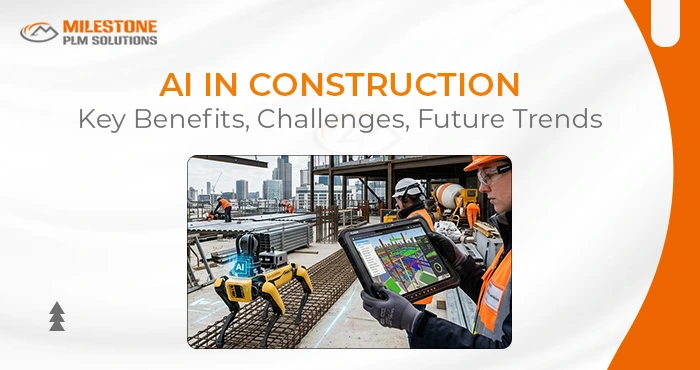
The construction sector is currently experiencing a revolution in technology that is propelled by Artificial Intelligence (AI). AI in construction is playing a major role in shaping future, starting from planning and coordination of designs to site management and predictive maintenance, AI is changing the way construction works are done.
Typically, the construction industry has always depended on manual processes, fragmented communications, and intuitive decisions. With growing complexities, shrinking timelines, and financial considerations, the construction industry is now utilizing artificial intelligence applications for greater efficiency and accuracy.
AI is not replacing construction professionals; rather, AI is improving decision-making through transforming large volumes of data collected from projects into meaningful insights.
What is AI in Construction?
Construction AI involves the application of machine learning algorithms, analytics, computer vision, and automation technologies to optimize the processes in construction project planning and implementation.
Construction AI algorithms have the capability to handle and analyze big data in construction from various sources, such as:
- BIM models (Revit, Navisworks)
- Construction drawings and shop drawings
- RFIs, submittals, and change orders
- BOQ and cost estimation sheets
- Site photos, CCTV feeds, and drone surveys
- IoT sensors from equipment and buildings
Instead of just storing data, AI interprets patterns, such as:
Where delays are likely to occur
- Which activities are affecting critical path
- Which design conflicts repeat across projects
- Where cost deviations are happening
This makes construction data usable for real decision-making instead of just documentation.
Why AI is Important in Construction?
Modern construction is not failing because there is no design or manpower; modern construction is failing because of lack of visibility and delayed decision-making.
AI becomes important because it solves real operational problems such as:
- Daily site progress not matching project schedule updates
- Delays detected too late (when damage is already done)
- Cost overruns identified only at final billing stage
- Coordination issues found during execution instead of design stage
- Productivity variations between subcontractors not tracked properly
In practice, AI helps project teams:
- Compare planned vs actual progress automatically
- Detect schedule slippage early using live data
- Identify productivity drop from daily reports
- Forecast delay impact on critical milestones
- Highlight risk zones before they become problems
This shifts construction from reactive management to predictive management.
AI in BIM (Building Information Modeling)
AI is emerging as a key enhancement layer in BIM coordination processes.
In practical BIM applications, engineers confront one common challenge:
👉 Thousands of clashes, yet only a few percent are really important.
The use of AI enhances BIM processes through smart model coordination.
In practical BIM workflows, AI helps in:
- Filtering clashes based on severity and system priority (MEP vs structure vs architecture)
- Detecting repeated clash patterns across floors or zones
- Grouping similar clashes into single actionable issues
- Identifying design elements that repeatedly cause coordination failures
- Predicting clash-prone zones before full modeling is complete
Instead of reviewing 2000 clashes manually, BIM teams can focus on 200 meaningful issues.
AI also supports:
- 4D BIM → linking model with construction schedule to simulate delays
- 5D BIM → detecting cost impact of design changes in real time
- Construction sequencing simulation → identifying execution conflicts before site work begins
This is where tools like Navisworks, Revit plugins, Synchro, and AI-based BIM platforms are increasingly evolving.
Benefits of AI in Construction (Practical View)
1. Real-Time Project Tracking (Not Manual Reporting)
Instead of relying on daily site reports, AI can:
- Compare drone images with BIM models
- Measure actual construction progress automatically
- Highlight work completed vs planned quantities
- Detect delays without waiting for site engineer reporting
2. Cost Control Through Early Deviation Detection
AI helps in:
- Comparing BOQ vs actual consumption trends
- Detecting abnormal material usage
- Identifying cost drift before monthly billing cycle
- Predicting cost overrun zones early
3. Site Safety Monitoring Using Computer Vision
AI-powered cameras and drones can:
- Detect workers without helmets or PPE
- Identify unsafe scaffold usage
- Monitor restricted zone entry
- Send real-time alerts to supervisors
4. Productivity Analysis Across Contractors
AI can analyze:
- Output per labor team
- Equipment idle time
- Subcontractor performance variation
- Delay causes at activity level
This helps in better contractor management decisions.
5. Reduced Rework Through Early Design Validation
Before construction starts, AI can:
- Detect constructability issues in BIM models
- Highlight missing coordination elements
- Reduce RFIs during execution phase
- Improve design clarity for site teams
Applications of AI in Construction (Real Industry Use)
1. AI in Design Stage (Architecture + BIM)
- Generative design for optimizing layouts
- AI-assisted space planning in architecture
- Automated design rule checking in BIM models
- Energy efficiency simulation for buildings
2. AI in Planning & Scheduling
- Predictive delay analysis using historical project data
- Critical path risk identification
- Resource allocation optimization
- Schedule clash detection between trades
3. AI in Construction Execution
- Drone-based progress tracking vs BIM model comparison
- AI-powered site inspection reports
- Equipment utilization tracking via sensors
- Real-time issue detection from site images
4. AI in MEP Coordination
- Detection of routing inefficiencies in ducting and piping
- Automatic clash prioritization between MEP systems
- Optimizing service routes in congested ceilings
- Reducing coordination cycles in BIM workshops
5. AI in Operations & Facility Management
- Predictive maintenance of HVAC systems
- Energy usage optimization in smart buildings
- Fault detection in electrical systems
- Digital twin-based building monitoring
Real-World Use Cases of AI in Construction
- AI-powered drones tracking structural progress on high-rise buildings
- Digital twins used for hospital and airport facility monitoring
- Predictive analytics identifying delay risks in infrastructure projects
- Computer vision systems monitoring worker safety compliance
- AI-based cost forecasting tools used in large EPC projects
Challenges of AI in Construction (Practical Ground Reality)
1. Poor Quality Project Data
Most construction data is:
- Unstructured (Excel sheets, PDFs, WhatsApp updates)
- Inconsistent across contractors
- Not updated in real time
AI fails if data input is not clean.
2. Lack of BIM Standardization Across Teams
- Different modeling practices across consultants
- Non-standard naming conventions
- Inconsistent LOD (Level of Detail) usage
- Poor coordination between disciplines
3. Resistance from Site Teams
Many site engineers still prefer:
- Manual reporting
- Experience-based decisions
- Paper-based tracking systems
This slows AI adoption on ground level.
4. High Integration Complexity
AI tools need integration with:
- BIM software
- ERP systems
- Scheduling tools (Primavera/MS Project)
- Site reporting systems
Integration is often difficult in real projects.
5. Lack of Skilled Hybrid Talent
Industry needs professionals who understand:
- Construction + BIM + AI tools
- Data interpretation from models
- Digital workflow management
But this skill combination is still rare.
Future Trends of AI in Construction
- AI-powered Digital Twins becoming standard in large projects
- Fully automated progress tracking using drones + BIM comparison
- Predictive construction planning replacing static scheduling
- AI-integrated BIM becoming default workflow in design firms
- Smart cities managed using AI + IoT + real-time infrastructure models
How Construction Companies Can Successfully Adopt AI
- Start with measurable use cases – Progress tracking, safety monitoring, or clash detection automation.
- Standardize BIM and data structure – Without standardization, AI cannot scale.
- Digitize site reporting first – Daily reports must move from manual to structured formats.
- Train teams for hybrid workflows – BIM + AI + project management integration skills.
- Focus on ROI-driven adoption – Cost savings, time reduction, and rework elimination must be measurable.
Looking for the Right Engineering and AEC Service Partner?
With the construction industry advancing an era of AI and digitalization, having the right engineering team will become increasingly important in ensuring that projects succeed. This includes everything from architectural designs, MEP engineering, BIM models, to coordinating shop drawings.
At Milestone PLM Solutions, offers complete solutions in the field of AEC & Engineering that will help you streamline your workflow. From Architectural Design to MEP Services, from BIM Modeling to CAD Documentation, we cover all bases to ensure better coordination and error-free delivery of projects.
We are also extending ourselves into Digital Twin solutions, making it possible to have a real-time virtual replication of physical objects for improved monitoring, simulation, and management throughout their lifecycles.
Are you searching for an engineering company that will offer digital support in your next project? Our team can be your perfect partner in bridging the gap between traditional construction methods and future-ready technologies.

Conclusion
Artificial intelligence is changing the way that the construction industry operates by changing the industry from a reactive form of management to a predictive one using data. This technology is being used within construction in several ways, making it relevant now, not in the future.
Nevertheless, for successful integration to occur, one needs good data, good teams, and good workflows.
Companies that use AI combined with BIM and construction in their operations will shape the AEC industry of the future.
Frequently Asked Questions
How is AI used in construction?
AI is used for planning, scheduling, estimating, BIM coordination, safety monitoring, quality control, predictive maintenance, and facility management.
Can AI replace construction engineers?
No. AI assists engineers by providing insights and automation, but professional expertise and decision-making remain essential.
How does AI work with BIM?
AI analyzes BIM data to improve clash detection, quantity takeoffs, scheduling, constructability reviews, and project coordination.
What are the biggest benefits of AI in construction?
Improved safety, better cost control, increased productivity, enhanced quality management, and predictive maintenance.
What is the future of AI in construction?
Future developments include AI-powered BIM, digital twins, construction robotics, generative AI documentation, and advanced predictive analytics.
Is AI useful for MEP projects?
Yes. AI helps optimize HVAC routing, clash detection, equipment placement, maintenance planning, and BIM coordination for MEP systems.